Why Do Cats Scratch Furniture? (And How to Save Your Sofa Without Punishment)

You come home, drop your keys, and there it is: a fresh set of pulled threads on the arm of the couch. If you share your home with a cat, you know the feeling. Here’s the good news — your cat isn’t being spiteful, you haven’t done anything wrong, and this is one of the most fixable problems in cat ownership.
The fix starts with understanding what scratching actually is.
Scratching is a need, not a bad habit
Cats don’t scratch to annoy you. They scratch because their bodies and brains are built for it. A single scratching session does several jobs at once:
- Claw care. Scratching pulls off the worn outer layer of each claw, exposing the sharp, healthy claw underneath. You may find these little crescent-shaped husks near favorite scratching spots — that’s normal.
- A full-body stretch. Watch a cat scratch after a nap: front paws planted high, back arched, shoulders and toes fully extended. It’s yoga with claws.
- Leaving a message. Cats have scent glands in their paws. Scratching leaves both a visible mark and a scent mark that says I live here. That’s why cats so often pick prominent spots in rooms you use most.
- Letting off steam. Many cats scratch when they’re excited — when you walk in the door, before a meal, after a burst of zoomies.
Because scratching meets real needs, you can’t train a cat to stop scratching. What you can do is decide where it happens.
Why your couch is so appealing
From a cat’s point of view, a sofa is close to the perfect scratching post. It’s tall enough for a full stretch. It’s heavy, so it doesn’t wobble or tip. It’s covered in a woven fabric that claws sink into with a satisfying pull. And it sits in the middle of the family’s territory, right where a scent mark matters most.
Compare that with the short, wobbly carpet post tucked in a back corner, and it’s easy to see why the couch wins.
Why punishment backfires
Yelling, clapping, or spraying water can interrupt a scratching session, but it doesn’t teach your cat what to do instead — and the need to scratch doesn’t go away. What cats tend to learn from punishment is that you are unpredictable, so they scratch when you’re not around. It can also add stress, and stressed cats often scratch more, not less.
You don’t need any of it. There’s a kinder plan that works better.
The plan: protect, redirect, reward
1. Protect the spots that are already targets
Cats return to the same places again and again, drawn by the texture and their own scent marks. So the first step is making those exact spots unrewarding.
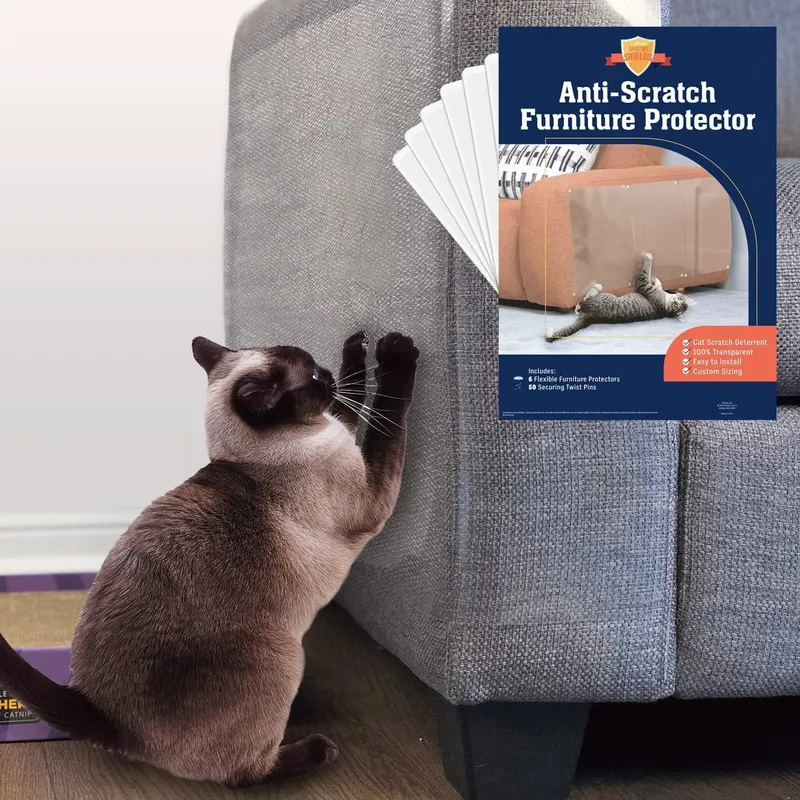
That’s what our shields are for. They’re clear, flexible sheets that cover the fabric with a smooth surface. Claws can’t sink in, so there’s no satisfying pull — the spot simply stops being fun. Because the sheets are transparent, your sofa still looks like your sofa. You’ll find the pack sizes on our products page, and a full walkthrough in how to install furniture protectors so they stay put.
2. Give your cat a better option, right there
Blocking a favorite spot without offering a replacement just moves the problem to the next piece of furniture. Put a sturdy scratching post right next to the protected area, so that when your cat heads over for a scratch, the good choice is the easy choice.
Not all posts are created equal — height, stability and material make a huge difference. We cover all of it in how to choose a scratching post your cat will actually use.
3. Reward the behavior you want
When your cat uses the post, make it worth their while: a treat, a chin scratch, a happy voice. A sprinkle of catnip or a wand toy dragged up the post can get a hesitant cat started. You’re not bribing your cat — you’re showing them where the good stuff happens.
4. Be patient for a few weeks
Habits take time to move. Most cats start using a well-placed post quickly, but leave the shields up well after the scratching stops. Once the post is clearly the favorite, you can gradually shift it to a spot that suits your room better — a few feet at a time.
A few extras that help
- Trim nails regularly. Every two to three weeks is a good rhythm for most indoor cats. Blunter tips do less damage during the transition. Your vet or groomer can show you how if you’re new to it.
- More cats, more posts. In multi-cat homes, scratching is partly about sharing territory. Aim for at least one scratching spot per cat, in different rooms.
- Look for the cause of sudden changes. If a cat who never scratched the furniture suddenly starts, think about what’s new — a move, a new pet, a change in routine. If anything about your cat’s behavior worries you, your veterinarian is always the right first call.
You can have both
A happy cat and a nice home aren’t competing goals. Cover the target, offer something better, celebrate the wins — and give it a few weeks. Your cat keeps doing what cats need to do, and your couch gets to stay a couch.