How to Choose a Scratching Post Your Cat Will Actually Use

Plenty of cat owners have bought a scratching post, watched their cat sniff it once, and then watched that same cat walk straight back to the sofa. It’s easy to conclude that your cat “just doesn’t like posts.”
Almost always, the real story is simpler: it was the wrong post, in the wrong place. Cats are picky about scratching surfaces for good reasons — and once you know what they’re looking for, picking a winner gets a lot easier.
What your cat wants from a scratching surface
Think about why the couch is so popular. It’s tall, it’s heavy, and the fabric gives claws something to grab. A good post copies all three.
Height: tall enough for a full stretch
Scratching is a stretch as much as anything else. A post needs to be tall enough for your cat to reach all the way up with their back fully extended — for most adult cats that means around 30 inches or taller. The short posts sold in a lot of stores are fine for kittens, but an adult cat has to hunch to use them, so they don’t bother.
Stability: no wobble, ever
This is the quiet deal-breaker. A cat puts real weight into a scratch, and a post that rocks or tips — even once — can put a cat off for good. Look for a wide, heavy base. If you already own a wobbly post, try wedging it into a corner or against a wall so it can’t move.
Material: something to sink claws into
Sisal — either rope or woven fabric — is the classic for a reason: it’s rough, it shreds satisfyingly, and it lasts. Many cats also love plain corrugated cardboard, which is inexpensive and easy to replace. Carpet-covered posts are a mixed bag: some cats enjoy them, but loops can snag claws, and they can blur the line between “scratch this” and “scratch the rug.”
Direction: vertical, horizontal, or both
Watch where your cat scratches now. A cat who goes for sofa arms and door frames is a vertical scratcher and wants a post. A cat who works on rugs and carpet is a horizontal scratcher and will be happier with a flat or angled cardboard pad. Lots of cats like both, and a mix costs very little.
Location matters as much as the post
A perfect post in the basement is still a post nobody uses. Cats scratch where life happens:
- Right next to the furniture they already scratch. This is the big one. You’re offering an alternative, so put it where the decision gets made.
- Near favorite sleeping spots. Cats love a good scratch-and-stretch right after waking up.
- In the rooms your family actually uses. Scratching is partly a way of marking shared territory, so a post in the living room beats a post in the laundry room every time.
You can always move the post later. Once it’s the clear favorite, shift it a few feet at a time toward where you’d prefer it to live.
Make the introduction easy
- Rub a little catnip or silvervine into the post, or drag a wand toy up it so your cat’s claws sink in mid-pounce. One good grab is often all it takes.
- Praise and treat when your cat uses it. Keep it cheerful and low-key.
- Don’t place your cat’s paws on the post and move them for them. Most cats dislike being handled that way, and it can turn them off the post entirely.
- Don’t throw out a shredded post too quickly. To your cat, a ragged, scent-marked post is a well-loved one. If it needs replacing, keep the old one beside the new one for a week or two.
Pair it with protection
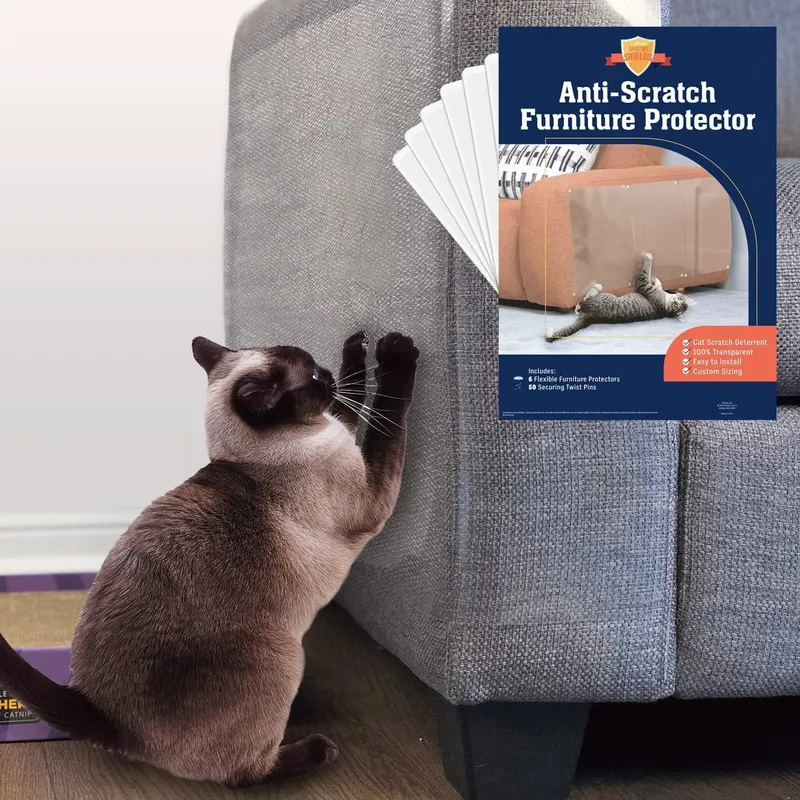
A great post gives your cat somewhere to go. But your couch has a head start — it already smells like a scratching spot, and the habit is well practiced. While your cat is learning, cover the old targets so the post becomes the better option by a mile.
That’s exactly what our clear furniture shields are for: they put a smooth surface over the fabric, so claws can’t get a grip and the spot stops being rewarding. Post beside it, shield on it, treats in your pocket — that combination is what changes the habit. See how to install furniture protectors so they stay put, or browse pack sizes to match your furniture.
For homes with more than one cat, plan on at least one scratching spot per cat, spread across different rooms, so nobody has to compete.
Give it a few weeks
Some cats take to a new post the same day. Others need a couple of weeks of encouragement. Both are normal. Keep the shields up, keep rewarding the good choices, and resist the urge to scold the slip-ups — if you’d like the reasoning behind that, read why cats scratch furniture.
Your cat isn’t trying to ruin your furniture. They’re just looking for the best scratching spot in the house. Your job is to make sure that isn’t the sofa.